
The Significance of the Valjoux 7753 and Why the Tissot Heritage 1973 Deserves Attention
There are movements that impress on paper, and there are movements that matter. The ETA Valjoux 7753 falls squarely into the second category. It isn’t decorative watchmaking theater. It’s industrial, proven chronograph engineering — and in the Tissot Heritage 1973, that distinction is exactly the point.
What Is the Valjoux 7753 Movement?
The Valjoux 7753 is a direct evolution of the legendary 7750 architecture — one of the most widely used automatic chronograph movements in modern Swiss watchmaking. Designed for durability and ease of service, the 7753 maintains the rugged cam-actuated chronograph system that made the 7750 famous while delivering a more balanced dial configuration.

Core Valjoux 7753 Specifications
Automatic (self-winding) chronograph
28,800 vibrations per hour (4Hz)
Approx. 60-hour power reserve (A05.H31 variant)
27 jewels
Cam-actuated chronograph system
3-6-9 tri-compax subdial layout
Date with case-side corrector
Swiss-made construction
This is a movement built to perform consistently under real-world wear — not one that demands delicate handling.
Why the Valjoux 7753 Is Historically Important
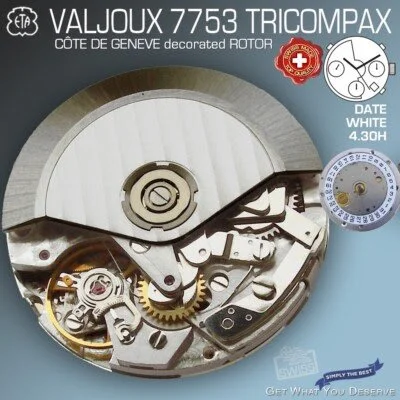
After the quartz crisis of the 1970s and early 1980s, the survival of mechanical chronographs depended on robust, scalable movements. The 7750/7753 family became foundational during the mechanical revival of the late 20th century.
Brands such as IWC, Breitling, Panerai, Longines, and TAG Heuer have relied on variations of this architecture because it offers:
Long-term reliability
Straightforward servicing
Modular adaptability
Tiered finishing potential
The 7753’s defining feature is its symmetrical 3-6-9 layout. Unlike the more common 6-9-12 configuration of the 7750, the 7753 delivers visual balance that collectors often associate with vintage chronograph design.
Cam-Actuated vs Column Wheel Chronographs
One of the most searched questions around the Valjoux 7753 concerns its cam-actuated chronograph system. While column-wheel chronographs are known for refined pusher feel and traditional prestige, cam systems are engineered for durability and repeatability.
The 7753’s pushers feel slightly firmer and more mechanical — a direct engagement rather than a silky theatrical click. For many collectors, that tactile honesty is part of the appeal. It prioritizes longevity over ornamentation.
Tissot Heritage 1973: Design and Specifications
The Tissot Heritage 1973 draws from the brand’s 1970s design language while remaining firmly modern in execution. Limited to 1,973 pieces, the production number references the era that inspired its aesthetic.
Case Specifications
43mm stainless steel case
46.6mm lug-to-lug
14.8mm thickness
Tonneau-shaped profile
Fixed tachymeter bezel
100 meters water resistance
Domed sapphire crystal with anti-reflective coating
Dial Details
Reverse panda configuration
Super-LumiNova hands and markers
Blue five-minute countdown accent in the minute counter
Classic tri-compax 3-6-9 layout
Movement: Calibre A05.H31
The Heritage 1973 is powered by Tissot’s Calibre A05.H31, derived from the Valjoux 7753 platform. It extends power reserve to approximately 60 hours while maintaining the core 4Hz beat rate. The movement is visible through the exhibition caseback, reinforcing that this is a mechanically driven chronograph at heart.
Strap and Finishing
The perforated leather strap nods to vintage racing straps from Tissot’s archives, secured with a butterfly clasp. The finishing overall is restrained — brushed steel surfaces balanced with polished accents — giving the watch presence without unnecessary flash.
Is the Tissot Heritage 1973 a Good Chronograph?
For collectors searching for a Swiss automatic chronograph with real mechanical pedigree, the Heritage 1973 offers several advantages:
Proven movement architecture
Balanced vintage-inspired dial design
Extended modern power reserve
Limited production run
100m water resistance for daily wear
It avoids the extremes of overly large cases or gimmick-driven complications. Instead, it focuses on proportion, symmetry, and mechanical reliability.
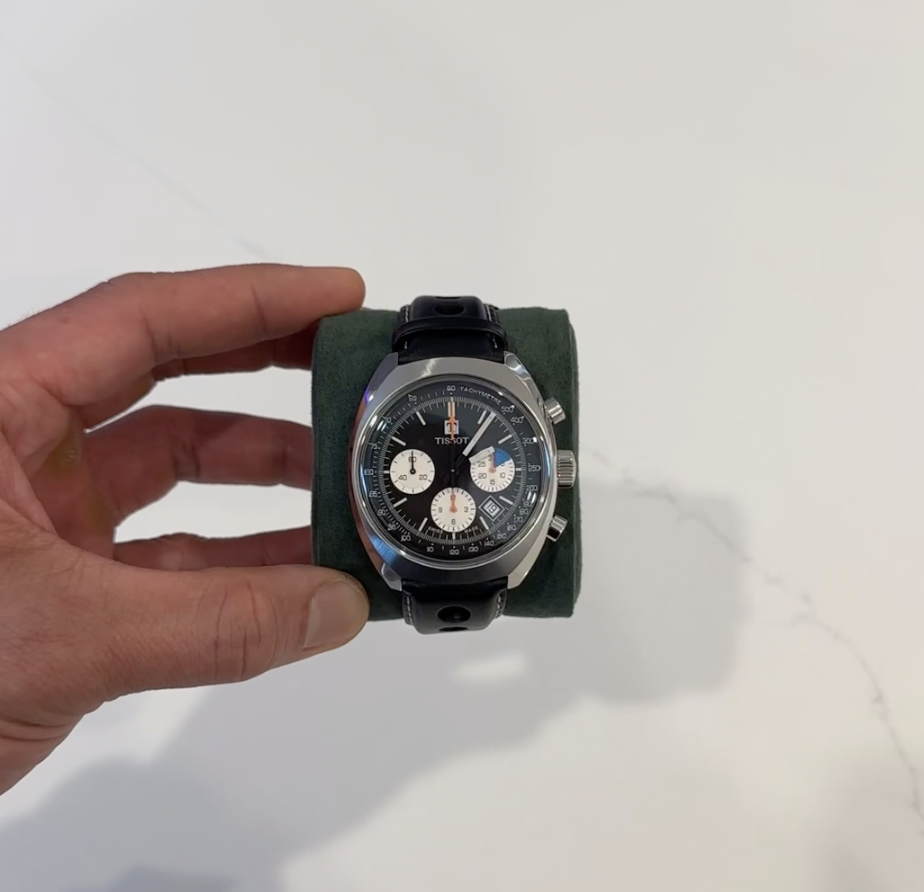
The Tissot Heritage 1973 channels the golden era of 1970s motorsport through a bold cushion case, tachymeter scale, and purposeful panda-style dial. Inspired by Tissot’s racing chronographs of the early ‘70s, this stainless steel edition pairs vintage proportions with modern reliability.
Inside beats the Valjoux-based automatic chronograph movement (Caliber A05.H31), built on the trusted 7753 architecture and upgraded with an extended power reserve. The result is a watch that feels period-correct on the wrist but performs to contemporary expectations — precise, durable, and engineered for use.
The integrated leather strap, applied indices, and pump pushers complete the look: unmistakably retro, yet undeniably wearable. For collectors who appreciate mechanical substance behind the aesthetic, the Heritage 1973 delivers both story and structure.
The Certified Authenticity Report (COA) is on it’s way from Watch CSA. We received the watch prior to the report.
Why We Added It to Our Inventory
At PR Timepieces, we look for watches that are mechanically sound, historically grounded, and wearable long-term. The Tissot Heritage 1973 checks those boxes. The Valjoux 7753 architecture inside it has powered serious chronographs for decades, and in this execution, it feels appropriately housed and thoughtfully finished.
This isn’t a hype-driven release. It’s a chronograph built on one of the most important automatic movement families of the last half-century.
If you value how a watch functions as much as how it looks, this is one worth considering — especially while it’s available.
